


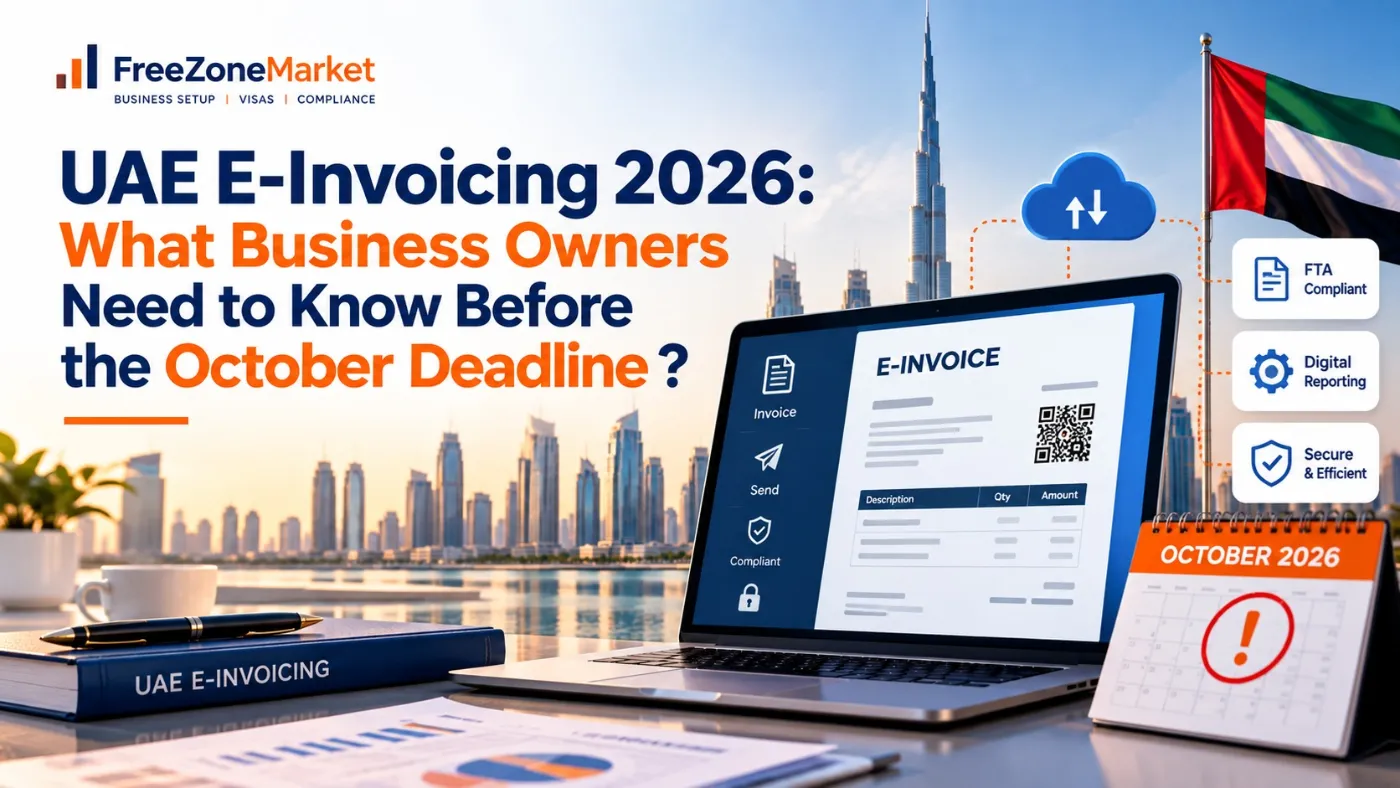
The UAE is moving toward a new era of digital tax administration with the introduction of e-invoicing. For businesses operating in the UAE, 2026 is an important year to understand the new requirements, assess accounting systems, and prepare for the upcoming implementation deadlines.
Whether you are an established company, a startup considering business setup in Dubai, or an entrepreneur planning company formation in Dubai, understanding UAE e-invoicing requirements can help you avoid last-minute compliance issues.
With businesses operating across the Dubai Free Zone, mainland UAE, and other free zones such as IFZA Dubai, Meydan Free Zone, Shams Free Zone, SPC Free Zone, Ajman Free Zone and DMCC, preparation should begin well before the applicable deadlines.
What Is UAE E-Invoicing?
E-invoicing is the electronic generation, transmission and processing of invoices in a structured digital format. Unlike simply sending a PDF invoice by email, an e-invoice contains structured data that can be processed electronically by accounting systems and tax administration platforms.
The UAE's e-invoicing framework is designed to support:
Faster and more efficient invoice processing
Improved tax compliance
Greater transparency in business transactions
Reduced manual accounting work
Better integration between businesses, accounting systems and tax authorities
More efficient VAT and Corporate Tax compliance
Businesses should therefore view e-invoicing as more than just a new invoicing format. It is part of the UAE's broader digital transformation of tax and financial administration.
Why Is 2026 Important for UAE Businesses?
The UAE is introducing e-invoicing through a phased implementation process. Businesses need to understand their applicable dates and make sure their accounting and invoicing processes can support the required electronic format.
For many business owners, October 2026 is an important preparation milestone. Rather than waiting until the deadline, businesses should use the months leading up to implementation to review their systems, accounting processes and service providers.
The exact obligations and implementation timeline can depend on factors such as the type of business, transaction type, VAT registration status and applicable e-invoicing requirements.
Who Should Prepare for E-Invoicing?
Businesses across different sectors should assess whether they will be affected, including:
UAE mainland companies
Free zone companies
VAT-registered businesses
Professional and consultancy businesses
Trading companies
E-commerce businesses
Service providers
Businesses issuing B2B invoices
Businesses conducting transactions with government entities
Companies established in popular free zones such as IFZA Dubai, Meydan Free Zone, Shams Free Zone, SPC Free Zone, Ajman Free Zone and DMCC should also review their accounting and invoicing processes.
Being registered in a free zone does not automatically mean a business can ignore UAE tax and digital compliance requirements.
E-Invoicing and VAT Compliance
E-invoicing should be considered alongside existing UAE VAT obligations.
Businesses should already maintain appropriate tax invoices, accounting records and supporting documentation. The move toward structured electronic invoicing will make accurate record keeping even more important.
Businesses should review:
VAT registration details
TRN information
Customer information
Supplier information
Invoice numbering
VAT calculations
Credit notes and adjustments
Accounting records
Transaction documentation
Data retention procedures
Incorrect or incomplete information in an accounting system can create problems when invoices are electronically processed.
E-Invoicing and Corporate Tax UAE
Businesses should also consider the relationship between e-invoicing and Corporate Tax UAE compliance.
The UAE Corporate Tax regime requires businesses to maintain appropriate financial records and supporting documentation. Properly structured electronic invoices can form an important part of a company's financial records and audit trail.
Businesses should therefore ensure that their invoicing system, accounting software and Corporate Tax records are properly aligned.
E-invoicing does not replace Corporate Tax compliance. Instead, it should be viewed as another important component of a company's overall financial and tax compliance framework.
What Should Business Owners Do Before October 2026?
The most important step is preparation.
1. Review Your Current Accounting System
Check whether your current accounting or ERP system can support UAE e-invoicing requirements.
If you currently prepare invoices manually using Word, Excel or basic PDF templates, you may need to consider upgrading your invoicing process.
2. Speak With Your Accountant or Tax Adviser
Discuss how e-invoicing will affect your business and whether your current accounting provider can support the required process.
Your accountant should also review your VAT and Corporate Tax records to ensure that your financial data is accurate.
3. Check Your Customer and Supplier Data
E-invoicing relies on accurate electronic information.
Review:
Legal company names
Trade licence details
TRNs
Addresses
Contact information
Customer classification
Supplier information
Incorrect master data can result in invoice processing problems.
4. Review Your Invoice Format
Your existing invoice may contain information that is suitable for a traditional PDF invoice but may not meet structured electronic invoicing requirements.
Businesses should review their invoice fields and accounting software configuration before implementation.
5. Train Your Finance Team
Employees responsible for sales, finance, accounts receivable and bookkeeping should understand the new process.
Training can help prevent common problems such as incorrect customer information, duplicate invoices and improper credit-note processing.
6. Review Your Accounting Service Provider
If your business uses outsourced bookkeeping or accounting services, confirm that the service provider is prepared for the e-invoicing transition.
This is particularly important for small companies that do not have an internal finance department.
What About New Businesses Setting Up in Dubai?
Entrepreneurs planning business setup in Dubai should consider accounting and tax compliance from the beginning.
A common mistake is to focus only on obtaining the trade licence and UAE residence visa, while postponing accounting and tax planning until the business starts generating revenue.
A better approach is to establish the company's accounting infrastructure at the time of incorporation.
For entrepreneurs considering company formation in Dubai, the setup process may include:
Selecting the appropriate business activity
Choosing mainland or free zone incorporation
Obtaining the trade licence
Opening a corporate bank account
Establishing accounting procedures
Assessing VAT obligations
Registering for Corporate Tax where applicable
Preparing for e-invoicing
Maintaining proper financial records
This approach can make future compliance significantly easier.
Does Free Zone Location Matter?
Many entrepreneurs choose a Dubai Free Zone because of the flexibility and range of business setup options available.
Popular jurisdictions include IFZA Dubai, Meydan Free Zone and DMCC, while businesses in Sharjah and Ajman may consider Shams Free Zone, SPC Free Zone and Ajman Free Zone.
However, selecting a free zone does not eliminate the need to understand UAE federal tax and compliance requirements.
Your free zone licence, business activity, revenue, customers and transaction structure should all be considered when determining your compliance obligations.
E-Invoicing for Companies With UAE Visas
For entrepreneurs establishing a UAE business, compliance extends beyond invoicing.
Depending on the company's structure and eligibility, business owners may also arrange a UAE residence visa, investor visa and, where applicable, a Golden Visa UAE.
While visa requirements and e-invoicing requirements are separate matters, both form part of the broader process of establishing and maintaining a compliant UAE business.
For example, an entrepreneur setting up a company in Dubai may need to consider:
Company formation → Trade licence → Corporate bank account → UAE residence visa → Accounting → VAT → Corporate Tax → E-invoicing
Planning these requirements together can make the overall business setup process smoother.
Common E-Invoicing Mistakes to Avoid
Businesses preparing for implementation should avoid the following:
Waiting Until the Deadline
System changes, software upgrades and accounting integrations may take time. Waiting until the last moment can create unnecessary pressure.
Assuming PDFs Are E-Invoices
A PDF invoice sent by email is not necessarily the same as a structured electronic invoice.
Ignoring Free Zone Compliance
Operating from a free zone does not automatically exempt a company from applicable federal tax and financial compliance requirements.
Using Incomplete Customer Data
Incorrect TRNs, company names or other customer information can create issues with electronic invoice processing.
Neglecting Credit Notes
Businesses should ensure their accounting systems can properly handle credit notes, refunds and invoice adjustments.
Treating E-Invoicing as an IT-Only Project
E-invoicing affects finance, accounting, sales and management processes. It should be treated as a business compliance project rather than simply a software upgrade.
How FZM Solutions Can Help
At FZM Solutions, we support entrepreneurs and businesses with UAE company formation, licensing, accounting and compliance-related services.
Our team assists businesses with different UAE structures, including companies established in:
DMCC
IFZA Dubai
Meydan Free Zone
Shams Free Zone
SPC Free Zone
Ajman Free Zone
Other UAE free zones and mainland jurisdictions
Our services can support businesses at different stages, from initial company formation in Dubai to ongoing licensing, visa and compliance requirements.
We can also assist business owners in understanding how accounting, VAT and Corporate Tax UAE requirements fit into their wider compliance obligations.
Final Checklist Before October 2026
Before the October milestone, UAE business owners should consider completing the following checklist:
Review whether your business falls within the applicable e-invoicing requirements
Check your accounting or ERP software
Confirm that your invoicing system can support the required electronic format
Review customer and supplier information
Verify VAT and TRN information
Review Corporate Tax records
Confirm your bookkeeping process
Train finance and accounting staff
Speak with your accountant or tax adviser
Test your invoicing workflow
Keep appropriate financial records
Plan ahead rather than waiting for the final deadline
Conclusion
UAE e-invoicing represents a significant step toward a more digital and transparent business environment.
For existing companies, now is the time to review accounting systems and prepare for the transition. For entrepreneurs planning business setup in Dubai or company formation in Dubai, e-invoicing should be considered as part of the company's financial and compliance infrastructure from day one.
Whether your company is established in DMCC, IFZA Dubai, Meydan Free Zone, Shams Free Zone, SPC Free Zone, Ajman Free Zone or another UAE jurisdiction, proactive preparation can help you adapt to the changing regulatory environment.
The October 2026 milestone should not be viewed simply as a deadline. It is an opportunity for UAE businesses to modernise their accounting processes, improve financial controls and build a stronger foundation for long-term growth.
Need help with UAE company formation, accounting, Corporate Tax, VAT or e-invoicing preparation?
FZM Solutions can assist you with your UAE business setup and ongoing compliance requirements.
Last updated 8 October 2026.
Ready to set up in the UAE? Talk to an advisor.
A free 30-minute call gets you a plan matched to your needs, with no obligation.